McKinsey’s latest report includes a surprising stat that should make every B2B marketer take notice.
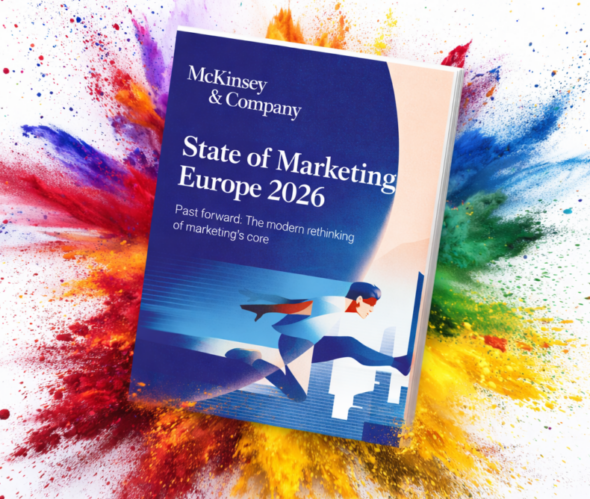
McKinsey has surveyed 500 senior marketing decision makers across the UK, France, Germany, Italy and Spain for their State of Marketing Europe 2026 report and it’s raised a few eyebrows here at our B2B marketing agency. As expected, branding came first, and budget management second in their list of top 20 priorities for this year. But AI? Sitting way behind in 17th place, right between macro developments and martech.What makes it so interesting is that the small group of European marketers who claim they are making AI their priority (just 6% rate their gen AI maturity as high) are already reporting efficiency gains of more than 20%. These are gains they’re either banking or reinvesting straight back into growth. If these early adopters are proof that the technology is working, then it raises a fair question: what’s holding people back?
What are B2B brands waiting for?
McKinsey makes it clear that it’s not just AI market trepidation as it does identify some real barriers to adoption, like weak data foundations or having no clear operating model in place. We can appreciate these are all genuine obstacles and not just excuses for businesses.What’s harder to explain, is the fact the marketers who are making progress aren’t necessarily the ones with the better tech or bigger budgets, they’re the ones who are getting stuck into the learning by doing.
B2B marketing has a bit of a rep for not committing to anything too hastily. We’ll happily spend months preparing an AI strategy, but when it comes down to running an experiment in real time, we're too busy today, thanks. The issue is, while we’re doing that, someone else (usually a competitor) is already forging ahead and gaining an AI advantage.
What the 6% of B2B marketing professionals who are prioritising AI already know
The front-runners in the McKinsey data sample know that they’re not just on the hunt for efficiency, but building a real, and compounding advantage as the months go by. Every use case they test or workflow they reshape, is a gap their competitors are essentially gifting them.McKinsey’s conclusion isn’t too subtle in stating that European brands that don’t accelerate their AI adoption risk losing ground to global peers who are moving with considerably more urgency. While that window for catching up is still open, it won’t be there forever. The difference between the 6% and the rest is about a willingness to actually play.
One of the reasons we feel B2B marketers have been slower to fully embrace AI is simply the pressure of the day job. Modern B2B marketing teams are already stretched managing an ever-growing mix of channels from social and content to events, email, paid media and sales enablement. Keeping all of these programmes running smoothly consumes huge amounts of time and attention.
As a result, the space required to properly explore new technologies like AI, to learn how they work, think about where they could add value, and test them in a meaningful way is often in short supply. The intent to adopt AI is there, but when teams are focused on maintaining the engine of day-to-day marketing activity, finding the time to step back and rethink how that engine could run differently becomes the real challenge.
The power of play in creative B2B marketing thinking
There’s another ingredient that McKinsey doesn’t talk about here and it’s one that we’ve always championed as an agency, that is, the power of play in creative thinking. Not just using tools or data, but the human instinct to reframe a problem, find an unexpected angle or to build something entirely different altogether.The brands that are inching ahead aren’t just technically capable but creatively more ambitious. When you bring Powerful Creative Thinking into play with AI to spark ideas, stress-test new concepts and push creative work further than a brief ever could, that’s when we believe things start to get interesting.

The Playground Principle
Let’s just pause there for a moment, because play really is a key word here. One of the biggest reasons we think B2B teams stall on AI isn’t through a lack of interest, it’s a lack of a safe place to get genuinely hands-on with it without the pressure of a live campaign or deliverable riding on the outcome. With more than 20 years in B2B, we understand this more than most, and it’s one of the very reasons why we are about to launch a new B2B AI Playground, built specifically for B2B marketers.Our goal was to create a space for B2B marketers to experiment with AI tools in a practical, low-stakes environment, making it possible to get real experience with real applications, rather than watching demos or just nodding along at another webinar. It’s the kind of hands-on learning that moves teams along from ‘we should probably do something about AI’ to ‘here’s what we’re doing about AI.’
Max Clark
Agency Founder & CEO
Share this article


It’s time to roll your sleeves up and get AI-experimenting!
While the McKinsey report is a good snapshot of where European marketing is right now, it should also serve as a warning about where the reluctant majority will find themselves in another year’s time if they don’t close the gap in AI. We’re willing to bet that the 6% of marketers aren’t smarter than you, the only difference is they’re ready to act.If you’d like to talk about how AI can give you a B2B marketing advantage, or to register to be one of the first to hear about the launch of our free B2B AI Playground, please get in touch hello@uppb2b.co.uk.